Whether you're a team of one or fifty, most businesses eventually hit the same wall. The tools that got you started stop keeping up, and you're left choosing between two options that both feel wrong.
Neither is a mistake on its own. Plenty of businesses run well on a handful of good apps, or on a platform like HubSpot. They become traps when the tools stop fitting the way you actually work.
Trap one: a tool for everything
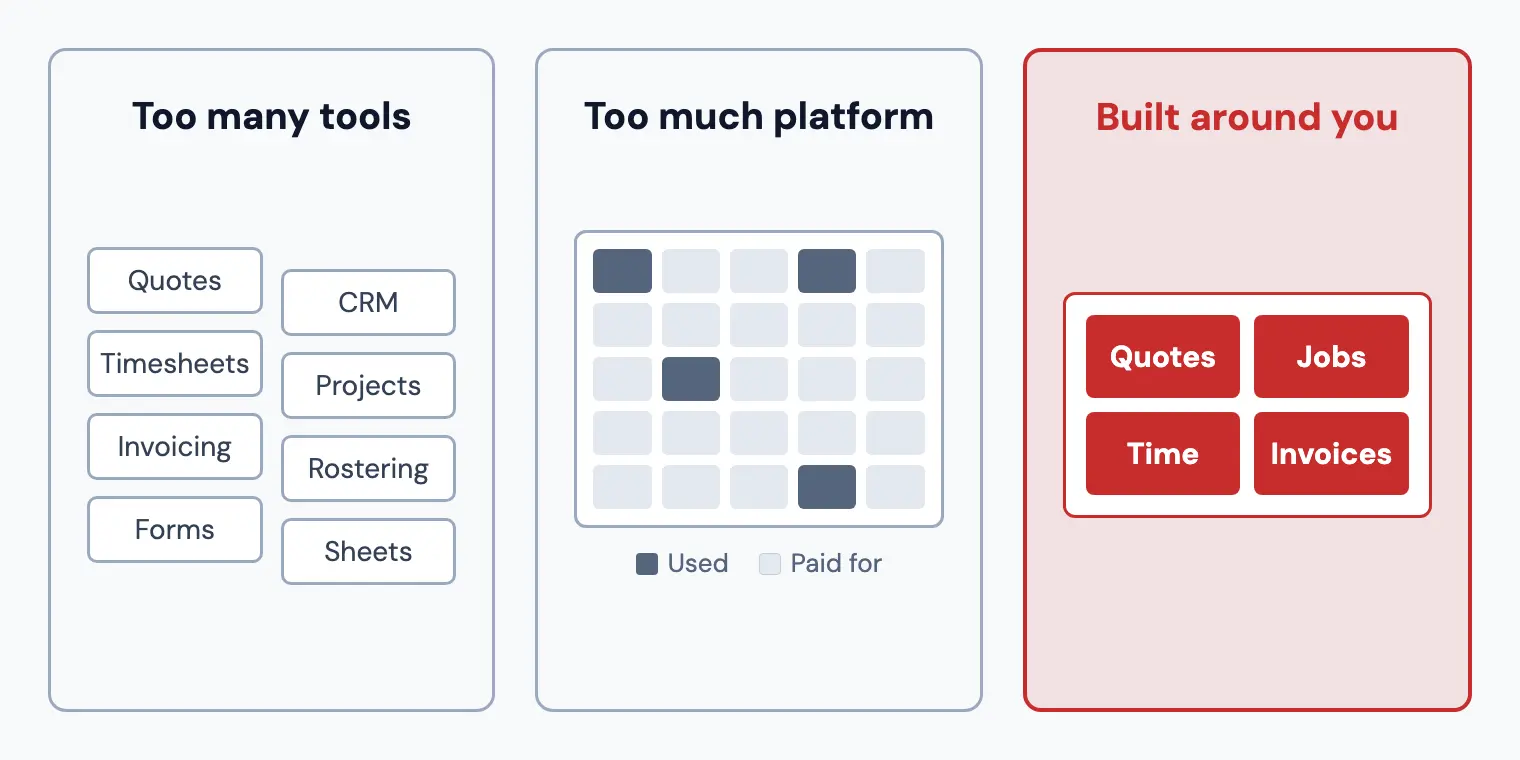
It starts sensibly. One app for scheduling, one for quotes, one for time, one for projects, one for customer records, and a few spreadsheets holding it all together.
The trouble isn't having several tools. It's when they overlap and don't talk to each other:
- Your information is split up. The customer is in one app, the job in another and the invoice in a third.
- People retype things. The same details get copied between systems, and mistakes creep in.
- The bill grows with your team. Most subscriptions are charged per person.
Harvard Business Review found people lose nearly four hours a week refocusing after switching between apps and websites. Every extra tool adds to that.
Trap two: one platform that does everything
The usual way out is to move everything into one of the big off-the-shelf, all-in-one platforms, like Salesforce or HubSpot.
They're built to serve thousands of different businesses at once, so you pay for everything and use a fraction of it. The platform has its own idea of what a lead, a job or a project is, and when that doesn't match how you work, your team works around it. Customising it to fit becomes an expensive project of its own.
Because it handles your particular work badly, extra tools start appearing around it. Before long, you're back in trap one.
The third option: a system built around you
The way out of both traps is a system designed around your business. Everything lives in one place, with one login and one set of data, which fixes trap one. It does only what you need, and fits the way your team works, not the other way around. That fixes trap two.
It also connects to the specialist tools worth keeping, like Xero and Microsoft 365, rather than replacing them.
What changed: AI
Until recently, a system like this was something only large organisations could justify. A tailored build meant a big team, a long timeline and a price to match.
AI-assisted development has changed that. Work that once took months now takes weeks, and McKinsey's 2026 State of AI survey found 32% of organisations had already decided against buying at least one software product because they could build it instead.
AI can also work inside the system itself. It can draft a quote from a job description, summarise a client's history before a call, or file an incoming email on the right record, all working from your own data and the way you do things.
A system built around you is no longer the expensive option, and over a few years it's often the cheaper one. For many growing businesses, a platform like Salesforce or HubSpot is no longer the sensible default.
We did it ourselves
We were living in trap one: Harvest for time, Trello for project boards, and a CRM bolted onto our website. So we built our own operations hub, "The Nest". It now handles:
- Leads and clients, plus proposals signed online
- Timesheets, with approved time turned into draft Xero invoices
- Project boards shared with clients
- Forwarded emails, filed on the right client record
The first version took about two months, and it keeps growing.
Built fast, but built to last
There's a fair worry here. The big platforms say software thrown together with AI isn't reliable enough to run a business on, and the same risk applies if you build something yourself. AI tools are great for prototyping what you need, but a rushed build that nobody understands or looks after can become a bigger problem than the one it solved.
The difference between a quick experiment and a system you can rely on comes down to four things:
- It's secure. Your customers' data is protected, and stays that way as things change.
- It's looked after. Updates and fixes carry on after launch, and someone understands how it works when something breaks.
- Someone else could pick it up. It's documented and tested, so you're never dependent on one person.
- You own it. The code and the hosting are yours.
That's how we build. We use AI to move faster, and our experienced engineers design, review and stand behind every line.
Does your software fit?
You don't have to replace everything at once. Most businesses start with the one process that causes the most pain, get it working well, and build out from there. That's how we built The Nest too.
If you'd like a hand working out where to start, get in touch. We'll look at the tools you use today, where the friction is, and whether a system built around your business makes sense. If it doesn't, we'll tell you.